Light Up the Tree: A Winter Memory Game for Sequences
Watch the tree lights blink, then tap them in the same order. How long a row can you remember?
Getting the game ready...
For grown-ups
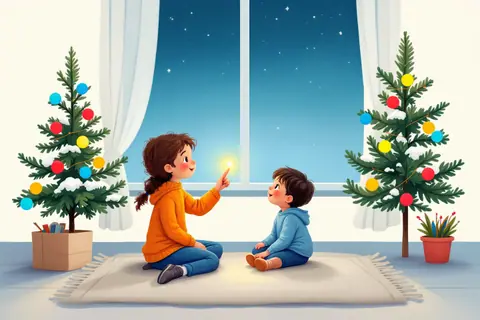
The lights on this little tree blink one at a time, and your child taps them back in the same order. Get it right and the tree adds one more light to the pattern. That is the whole game, and it is a surprisingly good workout for the part of thinking that holds a few things in mind while you use them. It suits children from about four (with a grown-up beside them and short patterns) up to ten or eleven, who will happily chase a personal best of twelve or more lights. There is also a counting mode, where the tree flashes a burst of lights and asks how many of each colour lit up.
What it practises, in plain terms
People call it working memory: the mental sticky note where you keep "red, blue, blue, yellow" for a few seconds while your finger does the tapping. Children use the same sticky note all day. "Put your boots on the mat, hang up your coat and bring me your lunch bag" is a three-step sequence. So is spelling a word, where the letters have to come out in the right order, and so is copying a sum from the board. A child who can hold four steps finds those moments easier than one who can hold two, and the good news is that playing with sequences is a gentle, low-stakes way to stretch that sticky note.
The counting mode works a different muscle. The child has to notice colour and keep a running tally at the same time ("two red, one green, wait, three red"). That is attention plus quick counting, and it pairs nicely with the matching in Word Pairs, where the job is remembering where things are rather than in what order.
Playing together
The first few rounds go better with you sitting beside them, saying the colours out loud as they blink. Naming turns a picture into words, and two kinds of memory are better than one. After a while, let your child do the naming. You will hear the strategies appear on their own: some children chunk ("red blue, red blue, yellow"), some hum, some tap their knee in rhythm.
Here is the kind of chatter that helps at the five-light stage:
Child: "I always forget the end." Grown-up: "Want to try saying it in two pieces? First three, then the last two." Child: "Green yellow green... red red." Grown-up: "That is exactly how phone numbers are remembered. Pieces."
Do not correct during the sequence. Let the game do the telling, then chat after.
How long to play
Memory games are tiring in a way that does not show until it suddenly does: one minute a child is focused, the next they are lying on the floor saying the tree is boring. Stop before that. A rough guide:
| Age | Good session | Typical sequence length | Sign it is time to stop |
|---|---|---|---|
| 4 to 5 | 5 minutes | 2 to 4 lights | Tapping at random, looking away |
| 6 to 7 | 5 to 10 minutes | 4 to 6 lights | Repeating the same mistake twice |
| 8 to 10 | 10 to 15 minutes | 6 to 10 lights | Frustration after a near miss |
| 11 and up | 10 to 15 minutes | 8 to 12 or more | Wanting "one more" four times |
Two or three short sessions in a week do more than one long one. Ending on a success matters, so if a round goes badly, offer a short pattern to finish on.
Making it easier or harder
Easier
Use the slow mode, which gives longer gaps between lights. Play as a team: you watch the first half, they watch the second, and you tap together. Let them say the colours while watching, out loud, every time. For a four-year-old, celebrate three lights as loudly as you would celebrate ten.
Harder
Ask them to tap the sequence backward (this is genuinely difficult, so expect a drop of two or three lights). Try counting mode with a twist: after the burst, ask "how many lights altogether?" so they have to add the colour totals. Older children can predict: "If the pattern so far is red, green, red, green, what do you think comes next?" The tree picks at random, so they will be wrong sometimes, which is a good little lesson about patterns and chance.
For children who find fast sequences stressful
Some children love the pressure. Others feel their stomach tighten when the lights speed up, and the game stops being play. If you see clenched hands, guessing or tears, switch to slow mode and leave it there for as long as they like. Take away the round counting by simply not mentioning it. Let them be the one who makes the pattern for you to copy, which puts them in charge. Our games keep no scores and store nothing, so there is no record to beat unless your child decides there is one.
An off-screen version with paper circles
You need coloured paper (four colours), a pencil, scissors and a large sheet with a triangle drawn on it for the tree.
- Cut four circles of each colour, about the size of a cookie.
- Glue one circle of each colour onto the tree as the "lights". Keep the rest loose.
- The leader touches the lights in an order while saying nothing. The player touches them back.
- Each round, the leader adds one touch.
- Swap roles every round, so nobody is always the one being tested.
For the counting version, the leader hides a handful of loose circles under a tea towel, lifts it for a slow count of three, then covers them again. "How many blue?" It is harder than it sounds.
A craft that keeps the pattern going
Paper chains are pattern practice in disguise. Cut strips in the tree colours and ask your child to build a chain that follows a rule: red, red, green, red, red, green. Then let them invent a rule for you to continue. Hang the chain near the window, and on a grey December afternoon you can point at a stretch of it, cover part with your hand and ask what is hiding there. If paper chains become a family habit, they also make a handy countdown, and the Learning Through Play section has more ideas in the same spirit.
What to watch for
Notice how your child remembers, not just how much. A child who names the colours, chunks the pattern or taps a rhythm has found a tool they can carry into spelling practice in Spelling Snake or into a long list of morning jobs. If you spot a strategy, name it for them: "You split it into two pieces. That is a clever trick." Then, the next time the instructions at the door get long, you can say "pieces, remember?" and watch the boots land on the mat.